
Austin MUD Tax Rates by Neighborhood (2026)

Austin MUD tax rates in 2026 run from about $0.20 to $0.90 per $100 of value in the neighborhoods I track. On a $600,000 home, that’s $1,200 to $5,400 a year just for the district. Add the county, school district and fire district on top, and the total property tax runs from about 1.9% to 2.7% of your home’s value. Here’s every number, neighborhood by neighborhood, pulled from the county tax offices.
Key takeaways
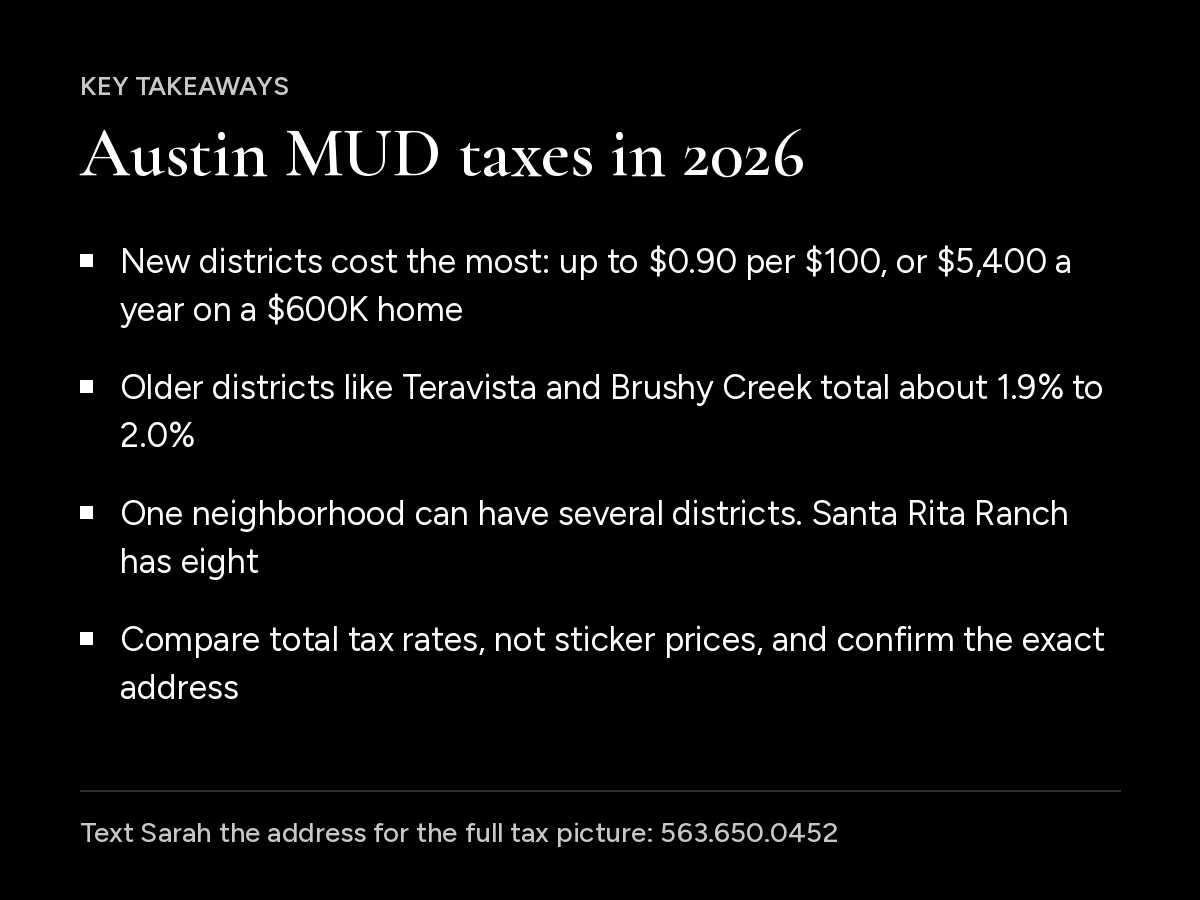
- The newest districts cost the most: Sunfield, Headwaters and Caliterra all charge $0.90 per $100 for the MUD alone
- Older districts like Teravista, Paloma Lake and Brushy Creek total about 1.9% to 2.0%, below Circle C inside Austin city limits (2.12%)
- One neighborhood can have several districts: Santa Rita Ranch has eight, from $0.49 to $0.85
- Compare total tax rates, not sticker prices, and confirm the exact address before you make an offer
What is a MUD tax in Texas?
A MUD (municipal utility district) is how a lot of newer neighborhoods around Austin paid for their water, sewer, drainage and roads. The district sells bonds to build all of it, and homeowners pay those bonds back through a tax rate that sits on top of the county, school and city rates. A WCID (water control and improvement district) works the same way, just under a different name.
A PID (public improvement district) does a similar job, but it usually bills each lot a set yearly installment instead of a rate. None of this is bad! A newer house in a MUD can still be the better deal. I just watch buyers fall in love with a kitchen, and then the tax bill shows up. Have you ever been surprised by a tax bill?
What are the 2026 MUD tax rates by neighborhood?
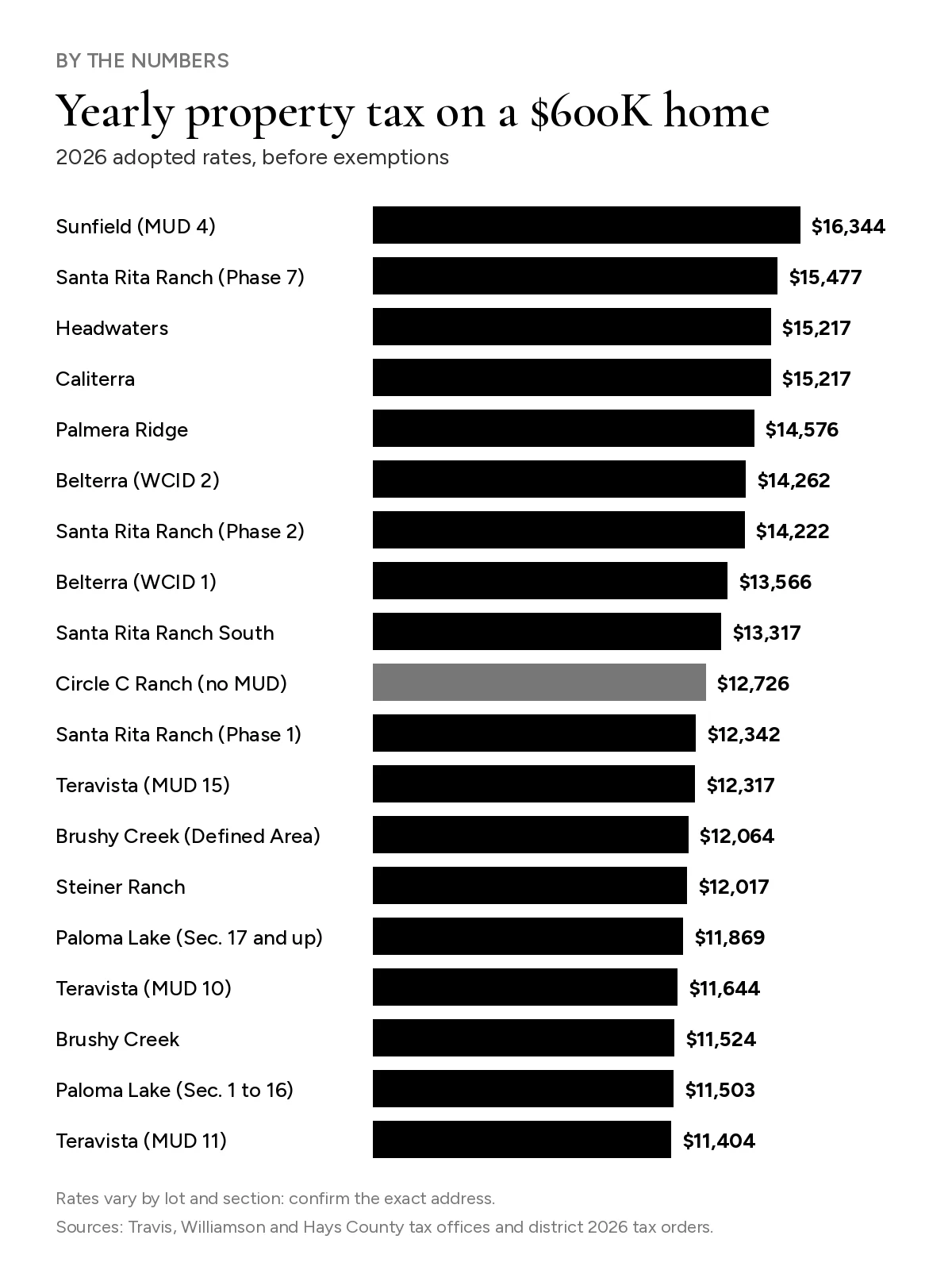
Rates are per $100 of value, so a total of 2.54 means 2.54% a year. The yearly amounts are for a $600,000 home before exemptions, sorted from the highest total to the lowest.
| Neighborhood | Area | MUD / district | District rate | Total rate | Yearly tax on $600K | District part |
|---|---|---|---|---|---|---|
| Sunfield (MUD 4 sections) | Buda | Sunfield MUD No. 4 | 0.90 | 2.72 | $16,344 | $5,400 |
| Santa Rita Ranch (Phase 7) | Liberty Hill (Liberty Hill ISD) | Williamson County MUD 19G | 0.85 | 2.58 | $15,477 | $5,100 |
| Headwaters | Dripping Springs | Headwaters MUD | 0.90 | 2.54 | $15,217 | $5,400 |
| Caliterra | Dripping Springs | Hays County Development District No. 1 | 0.90 | 2.54 | $15,217 | $5,400 |
| Palmera Ridge | Leander (inside city limits) | Palmera Ridge MUD | 0.40 | 2.43 | $14,576 | $2,400 |
| Belterra (WCID 2 sections) | Dripping Springs | Hays County WCID No. 2 | 0.74 | 2.38 | $14,262 | $4,445 |
| Santa Rita Ranch (Phase 2) | Liberty Hill (Georgetown ISD) | Williamson County MUD 19C | 0.85 | 2.37 | $14,222 | $5,100 |
| Belterra (WCID 1 sections) | Dripping Springs | Hays County WCID No. 1 | 0.62 | 2.26 | $13,566 | $3,749 |
| Santa Rita Ranch South | Liberty Hill (Liberty Hill ISD) | Williamson County MUD 19 | 0.49 | 2.22 | $13,317 | $2,939 |
| Circle C Ranch (no MUD) | Southwest Austin (inside city limits) | None | 0 | 2.12 | $12,726 | $0 |
| Santa Rita Ranch (Phase 1) | Liberty Hill (Georgetown ISD) | Williamson County MUD 19A | 0.54 | 2.06 | $12,342 | $3,220 |
| Teravista (Georgetown side) | Georgetown | Williamson County MUD 15 | 0.50 | 2.05 | $12,317 | $3,015 |
| Brushy Creek (Defined Area sections) | Round Rock / Cedar Park | Brushy Creek MUD + Defined Area | 0.50 | 2.01 | $12,064 | $2,982 |
| Steiner Ranch | Northwest Austin | Travis County WCID 17 + Steiner Ranch Defined Area | 0.20 | 2.00 | $12,017 | $1,198 |
| Paloma Lake (Sections 17 and up) | Round Rock | Paloma Lake MUD 2 | 0.45 | 1.98 | $11,869 | $2,685 |
| Teravista (MUD 10) | Round Rock | Williamson County MUD 10 | 0.41 | 1.94 | $11,644 | $2,460 |
| Brushy Creek | Round Rock / Cedar Park | Brushy Creek MUD | 0.41 | 1.92 | $11,524 | $2,442 |
| Paloma Lake (Sections 1 to 16) | Round Rock | Paloma Lake MUD 1 | 0.39 | 1.92 | $11,503 | $2,319 |
| Teravista (MUD 11) | Round Rock | Williamson County MUD 11 | 0.37 | 1.90 | $11,404 | $2,220 |
Please double-check before you count on these. Tax rates change every year, and two lots in the same neighborhood can sit in different districts. Use this as a starting point, then confirm the exact address with the county (links below). Or just text me the address and I’ll double-check it for you!
Totals include the county, school district, community college where it applies, city where the neighborhood is inside city limits, and fire/EMS districts. Your homestead exemption takes $140,000 off the school value, so a homestead’s real bill runs lower than these.
Why do some Austin neighborhoods pay thousands more in property taxes?
It’s mostly the age of the district. Sunfield, Headwaters, Caliterra and the newer Santa Rita Ranch sections sit at $0.85 to $0.90 for the MUD alone, because their bonds are young and they’re still paying for the pipes and roads. Older districts like Teravista, Brushy Creek and Paloma Lake have paid a lot of that debt down, so they land around 1.9% to 2.0% total.
North vs. south isn’t the story either. Some of the lowest totals on this list are north (Teravista, Paloma Lake, Brushy Creek), and so is one of the highest (Santa Rita Ranch’s newer sections). Palmera Ridge is a good example of the city piece: it’s inside Leander city limits, so it pays the city rate on top of its MUD. If you’re comparing two suburbs, my Cedar Park vs. Leander breakdown walks through taxes side by side too. Which of these surprised you most?
Does the same neighborhood always have the same tax rate?
Nope, and this is where buyers get caught. Big master-planned communities are often split into several districts, and the line can run right down a street:
- Santa Rita Ranch has eight MUDs, from $0.49 to $0.85, and Phases 1 and 2 are in Georgetown ISD while the rest are in Liberty Hill ISD. Total rates run from 2.06 in Phase 1 to 2.58 in Phase 7, about $3,100 a year apart on a $600K home.
- Belterra is split between two water districts, WCID No. 1 and WCID No. 2.
- Paloma Lake Sections 1 to 16 are in MUD 1, and Sections 17 and up are in MUD 2.
- Sunfield has three MUDs, and a few sections sit in Travis County instead of Hays County.
- Teravista’s Round Rock side is in MUD 10 or 11 and Round Rock ISD, while its Georgetown side is MUD 15 and Georgetown ISD.
- Parts of the Avaña section near Circle C are in Hays County and Hays CISD, not Travis County and Austin ISD.
How do I check the exact tax rate for an address?
- Look up the property on the appraisal district site: Travis CAD, Williamson CAD or Hays CAD. It lists every taxing unit on that lot.
- Look up each unit’s adopted rate: Travis County Tax Office, Williamson County Tax Office or Hays County’s tax database.
- Read the seller’s MUD notice before you sign. Texas requires it, and it shows the district’s rate and how much debt it still has.
Here’s what I’d actually do
Ok, honest take. I’d never rule out a neighborhood just because it has a MUD. Newer homes come with newer systems, builder warranties and sometimes big builder incentives, and that can more than cover a higher tax rate. But I’d run the numbers at the real total rate before I fell in love.
- Ask for the district’s rate history. A rate that’s dropped five years in a row tells a different story than one that just went up.
- Have your lender use the actual total rate, not a county average, when they estimate your monthly cost. My lender page has the people I trust.
- On new construction, look at what the builder is offering. A closing cost credit or rate buydown through their lender can offset years of the difference.
That’s totally your call, but this is exactly the stuff I dig into for my clients before we ever write an offer. The builder’s sales rep works for the builder. I work for you!
FAQ
What is a MUD tax in Texas?
It’s a property tax charged by a municipal utility district, which pays for the water, sewer, drainage and sometimes roads in a newer neighborhood. It shows up as its own line on your county tax bill.
How much is the MUD tax around Austin in 2026?
In the neighborhoods I track, MUD and water district rates run from about $0.20 to $0.90 per $100 of value. On a $600,000 home, that’s about $1,200 to $5,400 a year for the district alone.
What’s the difference between a MUD and a PID?
A MUD charges a tax rate on your home’s value. A PID usually bills a set yearly installment per lot from the district’s assessment plan, so it doesn’t move with your appraisal.
Do MUD taxes ever go down?
Often, yes. As a district pays down its bonds and more homes join the tax base, the rate tends to drop. It can also stay flat or go up if the district sells new bonds, so look at the last few years before you buy.
Does my homestead exemption lower the MUD tax?
Mostly no. The big $140,000 homestead exemption is for school taxes. A few districts offer a small exemption of their own, so check the district’s notice.
Which Austin-area neighborhoods have no MUD?
Most established neighborhoods inside Austin city limits, like Circle C Ranch, don’t have one. They pay the City of Austin rate instead, which is $0.579948 per $100 for 2026.
Want the full tax picture on a house?
Looking at a home in one of these neighborhoods? Text me the address at 563.650.0452 and I’ll pull the whole tax stack, plus what the district’s rate has done the last few years, before you make an offer. I actually answer! Shopping new builds? Here’s how I help with new construction.
Where these numbers come from: 2026 adopted rates from the Travis County Tax Office, the Williamson County Tax Office, Hays County, the Sunfield MUD No. 4 official statement, Travis County WCID 17, Hays County WCID No. 1, Hays County WCID No. 2, Headwaters MUD and each district’s 2026 tax order or notice. Which MUD and school district each Santa Rita Ranch and Paloma Lake section sits in comes from address lookups on the Williamson Central Appraisal District site. Leander ISD, Round Rock ISD and Georgetown ISD rates reflect the failed November 2026 tax rate elections. I update this every fall when new rates are adopted.
Connect with Sarah
- Watch Austin home tours on YouTube: youtube.com/@sarahsellsATX
- Instagram: instagram.com/sarahsellsatx
- Facebook: facebook.com/SarahsellsATX
- LinkedIn: linkedin.com/in/sarahmaddali
- Google reviews: read my reviews
- Compass profile: compass.com/agents/sarah-maddali
Sarah Maddali, REALTOR® | Serendipity Realty Group at Compass | 563.650.0452
Serendipity Realty Group is a real estate team affiliated with Compass. Equal Housing Opportunity. This page is general information, not tax or legal advice. Rates change every year and can vary by lot, so always confirm a specific address with the county tax office or contact Sarah to double-check it.