
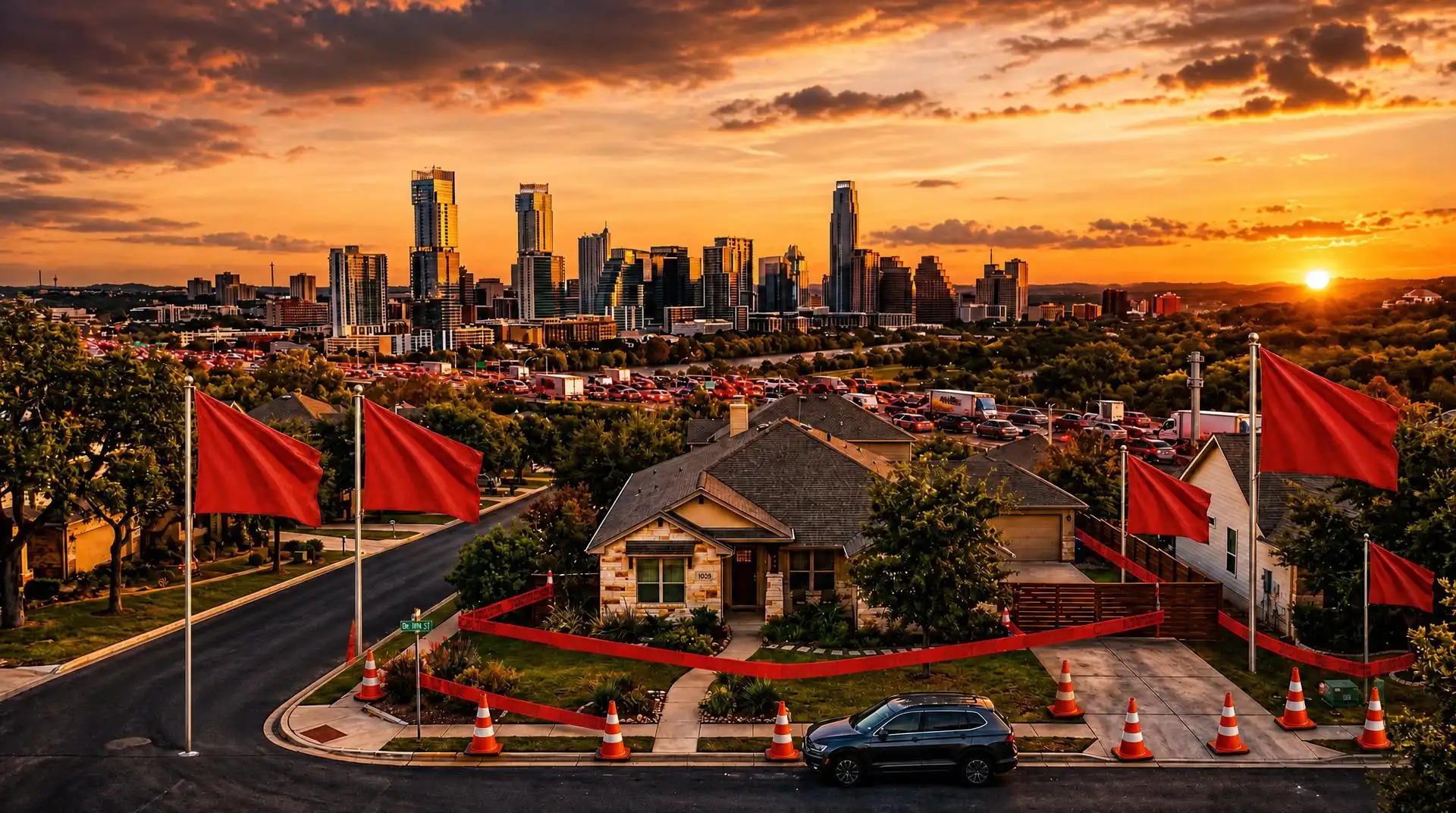
Where not to live in Austin Texas? Honestly, it’s not about a “bad” part of town. It’s about the house: a home in a flood zone, on a busy road, stuck behind years of I-35 construction, or carrying tax and HOA costs nobody warned you about. Those are the homes I steer my clients away from, and here’s exactly how to spot them.
Key takeaways
- Check the flood map before you fall in love. Austin’s maps changed, and thousands more properties are now considered high risk.
- Drive your commute at rush hour before you make an offer, not on a Sunday afternoon.
- Busy roads hurt resale. A neighborhood road behind you is fine.
- Ask for the total tax rate and HOA dues in writing, especially in new construction.
- Look at what’s planned on the empty land next door.
Why is “where not to live” really about the house?
Every part of Austin has streets I love and streets I’d skip. I explored this city one neighborhood a day when I moved here, and I can tell you the difference between a great buy and a regret is usually a few specific things about the property itself. Not the zip code.
So instead of a list of neighborhoods to avoid (which would be unfair and honestly not that helpful), here are the red flags I check on every single house. Which one surprises you most?
Is the home in a flood zone?
This is the big one. In 2018 the National Weather Service finished a rainfall study for Texas called Atlas 14, and the City of Austin has been updating its floodplain maps because of it (City of Austin). When the city plugged that data into its maps, around 3,000 more Austin properties landed in high-risk floodplains (KUT).
Why it matters to you:
- Homes in the 100-year floodplain usually have to carry flood insurance as part of the mortgage (KUT).
- A regular homeowners policy doesn’t cover flood damage. That’s a separate policy.
- Building or remodeling in a floodplain comes with extra rules.
What I do: I pull up the City of Austin’s FloodPro map and FEMA’s map for every house we look at, and I ask the seller for an elevation certificate if one exists. It takes five minutes and it can save you from the most expensive mistake in Central Texas. Would you have known to check both maps?

How bad is the commute, really?
Austin traffic isn’t a joke, and it’s about to get more interesting. TxDOT’s I-35 Capital Express Central project is a $4.5 billion rebuild of I-35 through central Austin, running from 2024 to 2033 (TxDOT). That means ramp closures, detours and lane shifts for years.
If your daily drive crosses central I-35, factor that in. A home that’s “20 minutes from downtown” on Google Maps on a Sunday can be a very different story at 7:45 on a Tuesday.
What I do: before you write an offer, drive the commute at the exact time you’d actually drive it. Morning and evening. If you’re relocating and can’t do that, I’ll do it for you and FaceTime you from the car. (I’ve done it. It’s not glamorous.)
Does the home back up to a busy road?
I say this in almost every home tour: don’t buy a house on a busy street. Your resale is almost always going to take a hit, because the next buyer is going to notice the noise and the traffic just like you did.
A neighborhood road behind the house? Totally different. Those don’t make me nervous, and sometimes they’re better than having five backyards staring into yours. What I’d skip is the home that sits right on a main road, a highway frontage road, or a future road expansion.
What I do: I look at the lot on a map, then I stand in the backyard and just listen for a few minutes. Your ears will tell you more than the listing photos ever will.
What are the real taxes and HOA costs?
This one sneaks up on people, especially with new construction. Two homes at the same price can have very different monthly costs because of the property tax rate, special districts (like a MUD or PID) in newer communities, and HOA dues.
Here’s the thing: some of those communities are worth every penny. If the HOA covers a lazy river, pools, trails and a gym you’ll actually use, that’s real value. But you should know the number before you fall in love, not after.
What I do: I get the total tax rate for that exact address, the HOA dues, and what the HOA actually covers, all in writing before we write an offer. Then we compare apples to apples. Does your current budget include HOA?
What’s being built next door?
That beautiful empty field behind the house? Ask what it’s zoned for. Central Texas is growing fast, and today’s quiet view can be tomorrow’s shopping center, apartment complex or business park.
Even small towns are changing quickly. In Buda, for example, a $90 million industrial development called Buda Midway broke ground on Firecracker Lane, between the Sunfield community and Amazon (Hays Free Press). That’s great for local jobs, and it’s also exactly the kind of thing you want to know about before you buy nearby.
What I do: I check city and county zoning and any approved plans around the lot. For new construction, I ask the builder’s sales rep directly what’s planned for every empty parcel around the community.
Are model home deals too good to be true?
Not always! End of the year, builders often get more aggressive on pricing because they want to close homes before the new year. Those can be real deals.
But the model home always has every upgrade, and the available homes aren’t always on the best lots. Before you jump on a deal, check the lot for everything above: flood risk, busy roads, what’s behind it, and the real monthly cost. A great price on the wrong lot isn’t a great deal.
My honest take: where I’d actually look
If you asked me over a glass of wine where not to live in Austin Texas, my answer would be this: don’t buy a home in a floodplain without knowing it, don’t buy on a busy road, don’t underestimate the commute, and don’t skip the tax and HOA math.
Everything else comes down to what you want your life to look like. Walkable and close in? Bigger house and a yard? Lake days? There’s a pocket of Austin for that, and part of my job is helping you find it without the regrets.
That’s totally your call, of course. I’ll just tell you the pros and cons and what helps resale, so you can make your own decision with all the facts.
FAQ
Where should you not live in Austin Texas?
Avoid homes in a mapped floodplain unless you understand the insurance and risk, homes directly on busy roads, and homes where the commute or the total monthly cost (taxes plus HOA) doesn’t fit your life. It’s about the specific property, not a whole neighborhood.
How do I check if an Austin home is in a flood zone?
Check both the City of Austin’s FloodPro map and FEMA’s flood map, since the city’s maps can be more restrictive. Ask the seller for an elevation certificate, and ask your agent to check before you write an offer.
Is I-35 construction going to affect my commute?
If your drive crosses central Austin, probably yes. TxDOT’s I-35 Capital Express Central project runs from 2024 to 2033, so plan for closures and detours. Drive the route at rush hour before you buy.
Are HOA communities in Austin worth it?
They can be, if the amenities match how you live. Get the HOA dues, what they cover, and the total property tax rate in writing so you can compare homes fairly.
Do I need my own agent for new construction?
Yes. The builder’s sales rep works for the builder. Many builders require you to register your agent on your very first visit, so bring yours from day one.
Let’s find the right pocket of Austin for you
Thinking about moving and want a second set of eyes on a house (or a whole area)? Text me at 563.650.0452. I actually answer! Or grab a time to talk: book a call.
Connect with Sarah
- Watch Austin home tours on YouTube: https://www.youtube.com/@sarahsellsATX
- Instagram: https://www.instagram.com/sarahsellsatx/
- Facebook: https://www.facebook.com/SarahsellsATX/
- LinkedIn: https://www.linkedin.com/in/sarahmaddali/
- Google reviews: https://share.google/GN08gDCGmLE0XDQZK
- Compass profile: https://www.compass.com/agents/sarah-maddali/
Sarah Maddali, REALTOR® | Serendipity Realty Group at Compass | 563.650.0452 Serendipity Realty Group is a real estate team affiliated with Compass. Equal Housing Opportunity.