

Let’s be honest: Austin is a driving city. But there are Austin walkable neighborhoods where you can leave the car parked and walk to coffee, tacos, the trail and dinner. My top picks are Downtown and Rainey Street, Clarksville, Hyde Park and North Loop, Bouldin and Travis Heights, East Austin, Mueller and the Domain.
I’m a Midwest girl who grew up driving everywhere, so walking to coffee and tacos still feels like a treat. Here’s what walking life really looks like in each spot, plus the trade-offs.
Key takeaways
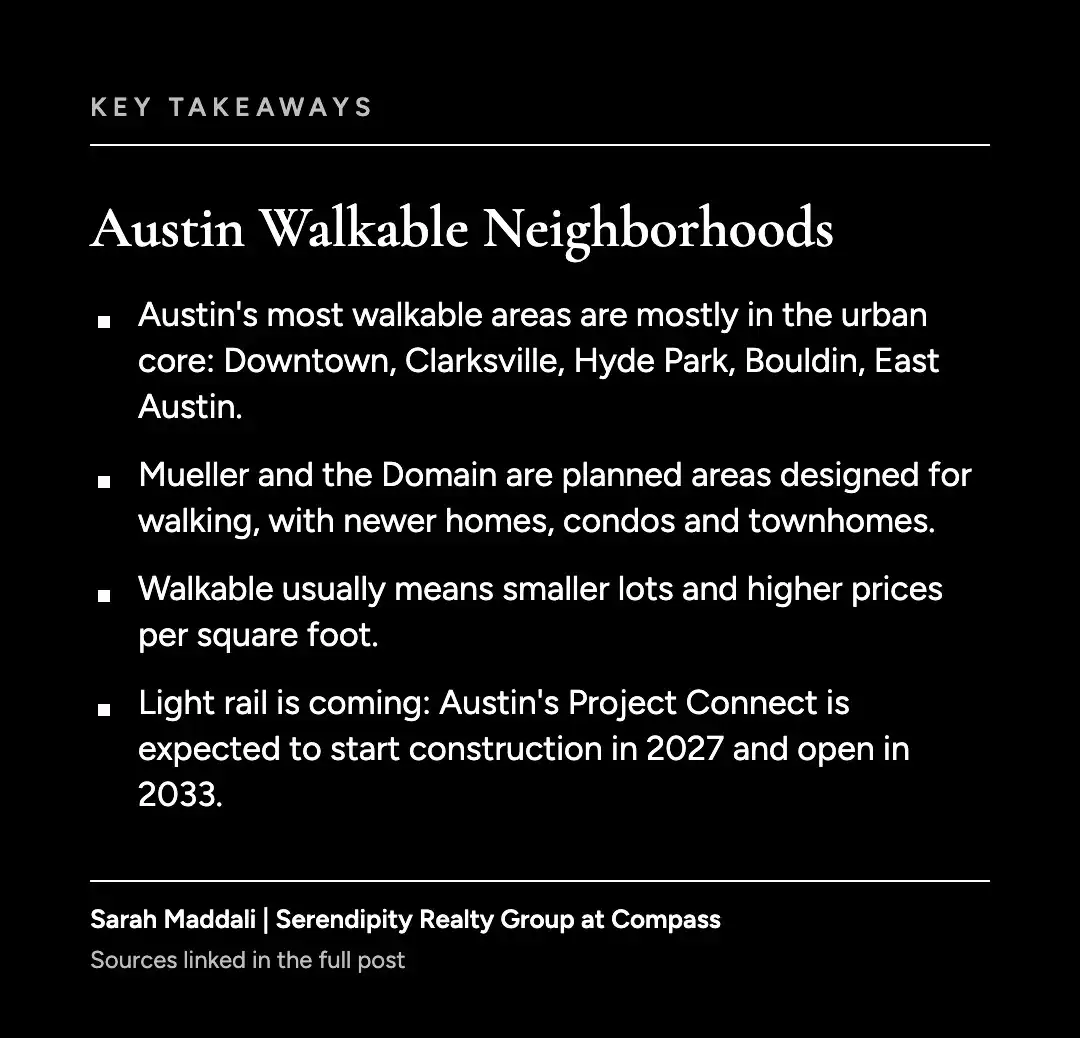
- Austin’s most walkable areas are mostly in the urban core: Downtown, Clarksville, Hyde Park, Bouldin, East Austin.
- Mueller and the Domain are planned areas designed for walking, with newer homes, condos and townhomes.
- Walkable usually means smaller lots and higher prices per square foot.
- Light rail is coming: Austin’s Project Connect is expected to start construction in 2027 and open in 2033.
Is Austin a walkable city?
Mostly no, with some really great exceptions. The city spread out fast, and a lot of neighborhoods were built around cars. But the core neighborhoods were laid out before that, and the newer planned areas were designed with walking in mind.
Austin is also working on transit. In January 2026, the Federal Transit Administration signed off on the environmental review for the first phase of light rail, and construction is expected to start in 2027 with an opening slated for 2033. So walkability near the future line is worth watching.
Do you want to walk everywhere, or just to a few favorite spots?
What are the most walkable neighborhoods in Austin?
1. Downtown and Rainey Street. High-rise condos, restaurants, live music, the Lady Bird Lake hike-and-bike trail and the Second Street District. You can walk to almost everything. Trade-off: HOA dues, noise and parking costs.
2. Clarksville. Just west of downtown, with small historic homes, tree-lined streets and West Sixth and West Lynn for coffee and dinner. It’s one of the oldest neighborhoods in Austin, and it feels like it in the best way. Trade-off: small lots and high prices.
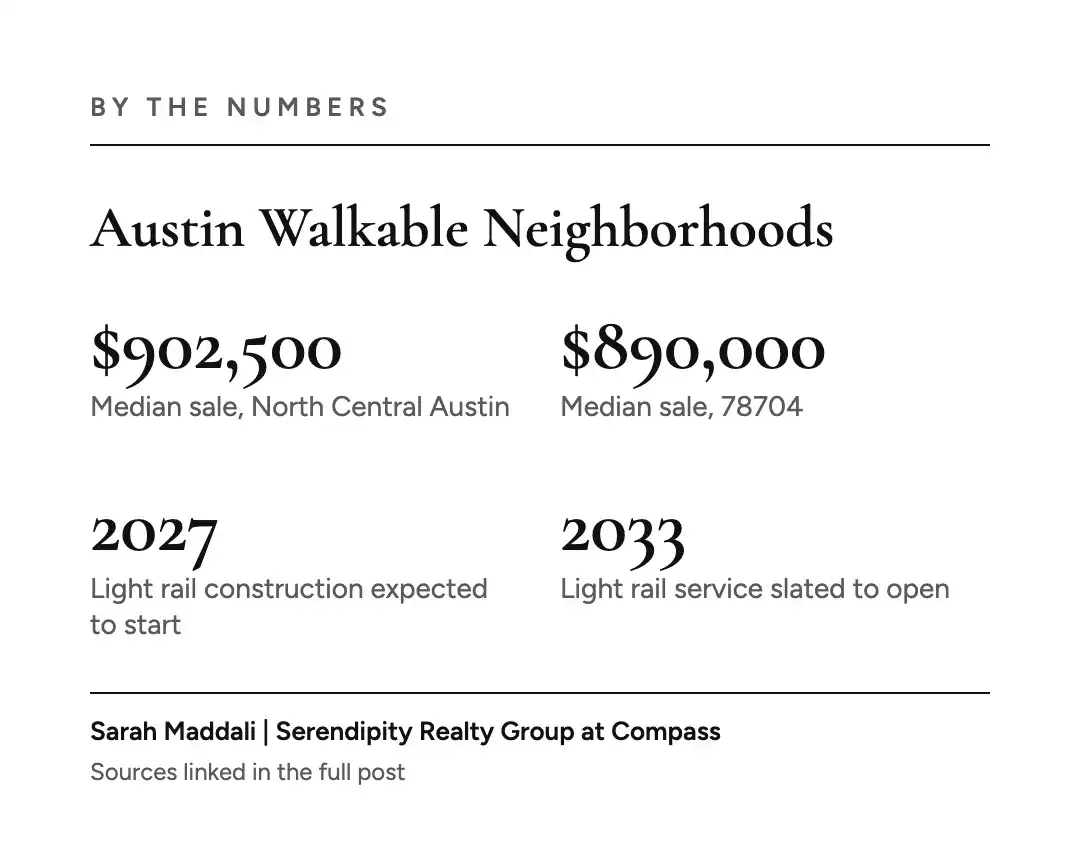
3. Hyde Park and North Loop. Front porches, old trees, coffee shops, vintage stores and a quick trip to the University of Texas. My MLS search of 78751, 78756 and 78757 showed a $902,500 median sale in the last 30 days. Here’s my North Central Austin homes update.
4. Bouldin and Travis Heights (78704). Walk to South Congress, South First food trucks, and for the lucky ones, Barton Springs Pool and Zilker Park. The median sale in 78704 was $890,000 in my last 30-day search.
Want walkable without overpaying? My 30-page relocation guide breaks down each of these neighborhoods with prices, trade-offs and my honest notes. Grab it free here.
5. East Austin (Holly, East Cesar Chavez, the Eastside). Coffee shops, breweries, taco spots and new restaurants on almost every block. Lots of new modern homes mixed in with older bungalows. Trade-off: a lot of construction, and it’s changing fast.
6. Mueller. A planned neighborhood on the old airport site, built for walking. There’s a big lake park, an H-E-B, restaurants, the Thinkery children’s museum and weekly events. Homes range from condos and townhomes to single-family houses with small yards and alley garages.
7. The Domain area. North Austin’s shopping and restaurant hub, with apartments, condos and some townhomes nearby. If you work in the tech offices up there, you can live, work and eat within a few blocks. Trade-off: it feels more like a shopping district than a classic neighborhood.
Which of these sounds like your kind of Saturday?
Are there walkable suburbs near Austin?
Sort of. Most suburbs are car-first, but a few have walkable downtowns you can live near:
- Georgetown: the historic square is full of restaurants, shops and events.
- Buda: historic Main Street with restaurants and city parks nearby.
- Liberty Hill: the city is actively planning a walkable downtown around its historic Main Street.
If you want a newer home and a little walkability, living close to one of these downtowns is a nice middle ground.
What should I know before buying in a walkable Austin neighborhood?
- Expect smaller lots. Walkable usually means closer neighbors and less yard.
- Check parking. Especially downtown and in East Austin, guest parking can be tight.
- Visit at night and on weekends. Fun on a Saturday afternoon can mean noise at midnight.
- Know your HOA. Condos and townhomes often have dues that cover exterior and amenities.
- Look at resale. Homes right on a busy street are harder to resell. One block in can make a big difference.
Text WALK to 563.650.0452 and I’ll send you homes for sale in the walkable neighborhood that fits your budget.
How much more do walkable Austin homes cost?
Usually a good bit more per square foot. In my last 30-day MLS searches, the median sale was $902,500 in North Central Austin and $890,000 in 78704, compared with $404,000 in South Austin’s 78745, 78747 and 78748. You’re paying for location, trees and the ability to skip the car.
A few ways to make walkable work on a budget:
- Look at condos and townhomes. They’re often the most affordable way into a walkable neighborhood.
- Go one neighborhood over. A home a few blocks past the busiest strip can cost less and still be a short walk or bike ride.
- Watch the homes that are sitting. Inventory is high in 78704 right now, and sellers there are negotiating.
My honest take
If walkability is your number one, start with Hyde Park, Bouldin, Clarksville or Mueller and decide whether you want older charm or newer and easier. If it’s a nice-to-have, look at a home a short drive from one of these hubs and you’ll save a lot. Here’s what I’d actually do: spend one Saturday morning walking two of these neighborhoods with a coffee in hand. You’ll know which one feels like you.
FAQs About Austin Walkable Neighborhoods
What is the most walkable neighborhood in Austin?
Downtown Austin is generally the most walkable, followed by central neighborhoods like Clarksville, Hyde Park, Bouldin and parts of East Austin. Mueller and the Domain are newer areas built for walking.
Is Austin a walkable city?
Austin is mostly car-dependent, but its central neighborhoods and a few planned areas are very walkable. Light rail construction is expected to begin in 2027, with service slated for 2033.
Are walkable neighborhoods in Austin expensive?
Usually, yes. In my recent MLS searches, the median sale was $902,500 in North Central Austin and $890,000 in 78704. Condos and townhomes can be a more affordable way into a walkable area.
Are there walkable suburbs near Austin?
A few suburbs have walkable downtowns, including Georgetown’s historic square and Buda’s Main Street. Liberty Hill is planning a walkable downtown too.
What should I check before buying a home in a walkable area?
Check parking, noise at night, HOA dues, lot size and whether the home is right on a busy street, which can affect resale.
Let’s find your walkable spot
- Get my free 30-page relocation guide on my links page.
- Ready to look? Search homes for sale or fill out my buyer questionnaire.
- Or text me at 563.650.0452. I actually answer!
Connect with Sarah
- Watch Austin home tours on YouTube: https://www.youtube.com/@sarahsellsATX
- Instagram: https://www.instagram.com/sarahsellsatx/
- Facebook: https://www.facebook.com/SarahsellsATX/
- LinkedIn: https://www.linkedin.com/in/sarahmaddali/
- Google reviews: https://share.google/GN08gDCGmLE0XDQZK
- Compass profile: https://www.compass.com/agents/sarah-maddali/
Sarah Maddali, REALTOR® | Serendipity Realty Group at Compass | 563.650.0452
Serendipity Realty Group is a real estate team affiliated with Compass. Equal Housing Opportunity.