
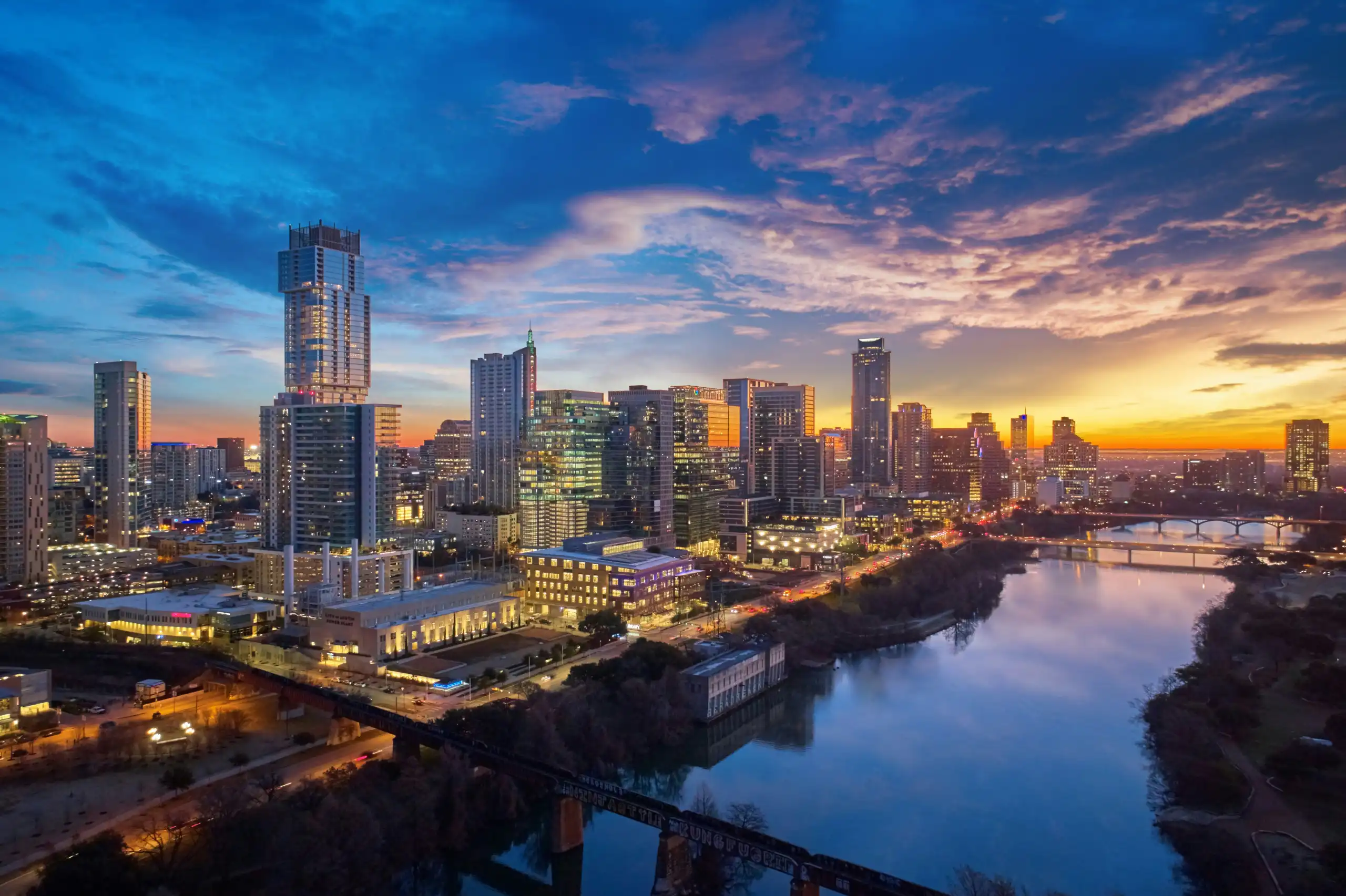
What to know before moving to Austin comes down to a few big things: the summers are long and hot, winter brings cedar fever, there’s no state income tax but property taxes are high, and where you live decides how much of your life you spend in traffic. Home prices have also come down from their peak, so buyers have more room to negotiate. As an Austin real estate agent, I walk people through this every week. Here are the nine things I’d want to know first.
Key takeaways
- Austin averages about a month of 100-degree days a year, mostly in July and August.
- Cedar fever season runs roughly December through February.
- Texas has no state income tax, but property taxes are high. File your homestead exemption.
- Check flood maps for every home you look at.
- Where to live in Austin Texas matters more than the house itself, because of the commute.
1. How hot does Austin really get?
Hot. Austin averaged 29 days of 100 degrees or more a year from 1991 to 2020, and the record is 90 days in 2011 (KXAN). August is usually the peak. The trade-off is a long patio season. October through May is gorgeous, and we eat outside year round.
House tip: look for shade trees, a covered patio, a newer AC system and good attic insulation. A west-facing backyard gets the full afternoon sun, so I always check which way a home faces.
2. What is cedar fever?
Cedar fever is a winter allergy caused by mountain cedar (juniper) pollen. Season usually runs from December through February, with the worst of it in late December and early January (Fox 7 Austin). Plenty of people who never had allergies get it here. Keep that in mind if you’re moving in winter.

3. How much do homes cost in Austin right now?
In August 2026, the median home price was $560,000 in the City of Austin and $412,000 across the whole metro (Unlock MLS). Austin prices were down 4.3% from a year earlier, with 4.6 months of inventory. Suburbs like Williamson County ($399,900) and Hays County ($355,000) cost less.
Austin real estate is a buyer-friendlier market than it was a few years ago. Sellers are negotiating and builders are offering incentives. That’s a good thing to know before you start touring.
4. Does Texas have a state income tax?
No. Texas has no personal income tax (Texas Comptroller). But property taxes are a big part of your monthly payment, and the rate depends on the exact address. Newer communities may add a MUD or PID.
The good news: Texas voters raised the school district homestead exemption from $100,000 to $140,000 in November 2025 (Fox 4). Once you own and live in your home, file for it with your county appraisal district. It’s free.
5. What’s traffic like in Austin?
Real. TxDOT is rebuilding I-35 through central Austin in a $4.5 billion project running from 2024 to 2033 (TxDOT). You’ll also hear a lot about toll roads like 183A, SH 130, SH 45 and the MoPac Express Lanes. They save time, but budget for them.
My rule: drive your commute at the time you’d actually leave before you pick a neighborhood. Fifteen minutes on a map can be 45 at 8 a.m.
6. Do you need to worry about flooding in Austin?
You need to check, every time. Central Texas gets intense rain, and when the City of Austin updated its flood maps with new rainfall data, about 3,000 more properties moved into high-risk floodplains (KUT). Look up any address on the FEMA Flood Map Service Center, and ask about flood history and insurance before you write an offer. I cover this and other red flags in where not to live in Austin Texas.
7. Where should you live in Austin Texas?
Start with your daily life, not the house. Austin Texas neighborhoods close in, like Hyde Park, Crestview, Zilker and Travis Heights, give you walkability and character. Suburbs like Round Rock, Cedar Park, Pflugerville and Buda give you newer homes and more space. Hill Country areas like Dripping Springs and Driftwood give you land and views.
Want to dig in? Read Round Rock vs Austin, my guide to Dripping Springs and Driftwood or watch my Sunfield lazy river home tour.
8. How is buying a home in Texas different?
A few things surprise out-of-state buyers. Most buyers pay an option fee for an option period, a set number of days to do inspections and back out for any reason. Closings run through a title company. With our clay soil, foundation movement is common in older homes, so a good inspection matters. And with new construction, you want your own agent, because the builder’s sales rep works for the builder.
Moving from the West Coast? Read moving from California to Austin for the side-by-side on costs.
9. What do people love most about living in Austin?
The outdoors and the food. Barton Springs, Lady Bird Lake, Lake Travis and the swimming holes are your summer. Breakfast tacos are a food group. Live music is everywhere, and there’s always a new restaurant to try. (I’m always up for a spicy food challenge, and Austin has plenty.) And most of the people you meet are from somewhere else too. I’m from Iowa, so I get what it’s like to start fresh here.
My honest take on what to know before moving to Austin
If I could only tell you one thing about what to know before moving to Austin, it’s this: the neighborhood you pick shapes your daily life more than the house does. The commute, the tax rate, the flood risk and even how hot your backyard gets all come down to location. Here’s what I’d actually do. Visit in August once, so you know what you’re signing up for. Pick two or three areas based on your commute, not Instagram. Check the flood map, the tax rate and the HOA for every home you like. Then take your time. The market is giving buyers room right now, so there’s no reason to rush into the wrong house.
FAQ
What should I know before moving to Austin?
Expect long, hot summers, winter cedar fever, no state income tax but high property taxes, growing traffic and the need to check flood maps. Where you live will shape your commute and your budget more than anything else.
What is the best month to move to Austin?
Fall and spring are the most comfortable months for moving. Summer moves are hot, and winter can bring cedar fever. If you can, visit once in summer before you commit.
Is Austin a good place to buy a house right now?
Buyers have more options than a few years ago. In August 2026, the City of Austin’s median price was $560,000, down 4.3% from a year earlier, with 4.6 months of inventory, according to Unlock MLS.
Do I need a car in Austin?
For most people, yes. A few close-in neighborhoods are walkable and bikeable, but most of the Austin metro is built around driving.
When is cedar fever season in Austin?
Usually from December through February, with the worst pollen in late December and early January.
Planning your move?
Grab my free Austin relocation guide. It covers every Austin Texas neighborhood and suburb, plus all my insider tips: get the guide here. Or text me at 563.650.0452 with your move date and I’ll help you build a plan.
Connect with Sarah
- Watch Austin home tours on YouTube: https://www.youtube.com/@sarahsellsATX
- Instagram: https://www.instagram.com/sarahsellsatx/
- Facebook: https://www.facebook.com/SarahsellsATX/
- LinkedIn: https://www.linkedin.com/in/sarahmaddali/
- Google reviews: https://share.google/GN08gDCGmLE0XDQZK
- Compass profile: https://www.compass.com/agents/sarah-maddali/
Sarah Maddali, REALTOR® | Serendipity Realty Group at Compass | 563.650.0452
Serendipity Realty Group is a real estate team affiliated with Compass. Equal Housing Opportunity.